
Ambiguity, racism, or pure art? Can art ever be free from the biases of its time
- Ana Paula Brandão

- há 2 dias
- 2 min de leitura
The history of European art named and celebrated kings, queens, aristocrats, and members of the white elite. We know who they were, where they lived, and the positions they held. Their portraits preserved not only their faces, but also their biographies and status.
When the people portrayed were Black, their names disappeared. All that remained was their race, territory, or a generic classification. Rather than individuals, they became “human types”: the different, the distant, the exotic.
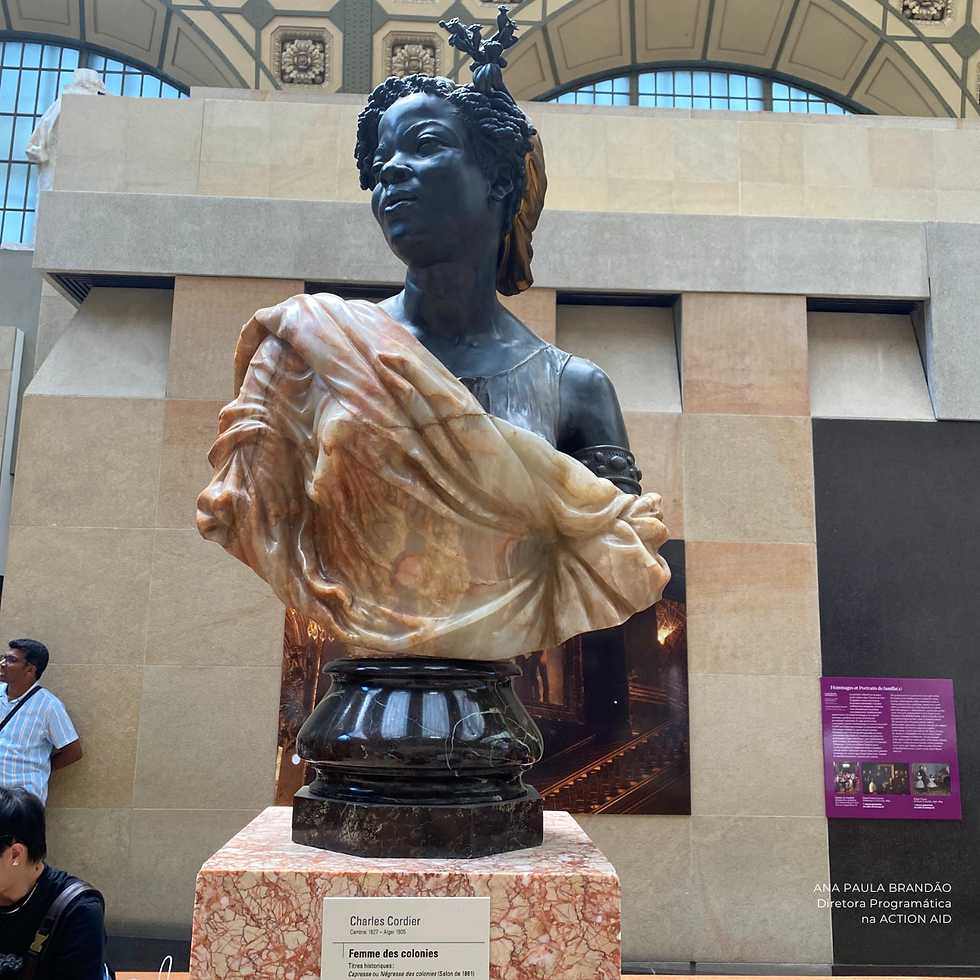


Three sculptures encountered during a visit to the Musée d’Orsay in Paris help us understand the colonial mindset of an era.
In 1861, Charles Cordier presented at the Paris Salon the bust now known as Femme des colonies. Its original title used terminology drawn from French racial classifications.
Cordier is known to have argued that beauty did not belong to a “privileged race.” A pioneer of polychrome sculpture, he gave this woman a monumental presence: her head held high, her expression proud, rendered in patinated bronze with gilded ornaments and onyx.
There is beauty and dignity in the representation. And that is precisely where its ambiguity lies.
Cordier probably encountered the model in Paris. She was a real person, yet we know neither her name nor her story. The artist preserved her features but presented her as the representative of a racial and colonial category.
The same erasure is present in Herbert Ward’s two sculptures, produced between 1900 and 1902.
Femme d’Afrique centrale was also known as Jeune fille de Bâ Kongo and Type de femme. We see a specific woman, an individualized face, ornaments, and a distinct expression. Yet we do not know her name—only her classification.
The third work was given an even more disturbing title: Souvenir de voyage de l’expédition Stanley. The young man portrayed is not presented as the subject of his own story, but as an exotic souvenir of a European man’s experience in Africa.
Ward worked in the Congo Free State, then the private property of King Leopold II, and took part in Henry Morton Stanley’s expedition. Years later, he created these bronzes from drawings and memories brought back to Europe.
Who was allowed to tell this story? Those who travelled, drew, classified, named, and signed the works—not the people whose faces were appropriated and transformed into objects, without our even knowing whether they had consented.
To analyse these sculptures is not to deny their technical quality. It is to understand the mindset of an era in which white Europe granted itself the right to observe, classify, represent, and symbolically possess other peoples.
Beauty does not erase violence. In some cases, it may even make violence less visible.
Standing before these busts, we are not merely looking at three images. We are facing three people whose names disappeared, while the names of their artists endured.
Three people. Three identities stolen and transformed into images for the benefit of whiteness.
This is a reflection that transcends time. As Saidiya Hartman helps us understand in Venus in Two Acts, silence is neither an accidental void nor simply an absence of information. It was also historically produced by structures of power that determined who could be recognized as a subject—and who could not.


Comentários